
2026 Incident Response Report; Attacks Are Speeding Up!

Security teams are facing a massive paradigm shift in attacker speed, automation, and stealth. In February 2026, Palo Alto Networks published its highly anticipated. Unit 42 Global Incident Response Report 2026, analyzing more than 750 major cyber incidents across 50 countries. The defining takeaway for cybersecurity engineers, analysts, and managers is empowering: over 90% of data breaches were enabled by completely preventable gaps -such as configuration drift, limited visibility, or excessive identity trust - rather than highly sophisticated zero-day exploits.
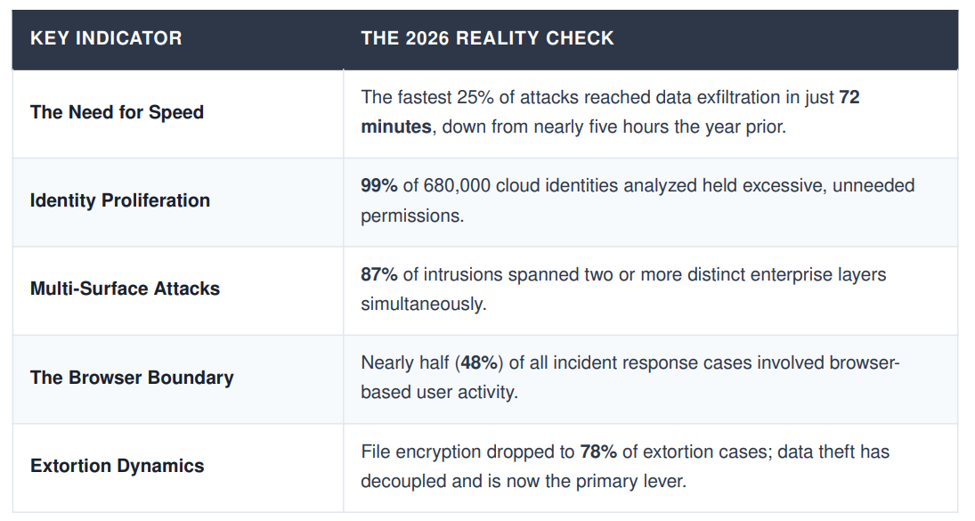
Security Metrics at a Glance
The operational reality of modern security telemetry highlights a critical compression of time and an expansion of access vectors.
The 4 Massive Trends Reshaping the Threat Landscape
AI is an adversarial friction reducer. AI has transitioned from an experimental tool to a routine component of the attacker workflow. Threat actors are now automating exploitation loops, scanning for vulnerabilities within 15 minutes of a CVE Unit 42 Incident Response Report Blog Summary 1 announcement. This completely erases the traditional buffer window security teams have to manually audit and patch internet-facing infrastructure.
Attackers aren't breaking in; they are logging in. Identity weaknesses played a material role in nearly 90% of investigations. With 65% of initial access driven by identity-based techniques (such as session hijacking, MFA circumvention, or credential reuse), attackers easily blend into normal traffic to escalate privileges and move laterally.
Software supply chain and SaaS integration exploitations are bold. Adversaries are bypassing traditional perimeters by misusing trusted third-party cloud connections. SaaS application data was relevant in 23% of cases (up from just 6% in 2022). Furthermore, over 60% of cloud-native vulnerabilities now sit silently in indirect transitive libraries inherited during automated build steps.
Persona-driven nation-state tactics still matter. State-aligned groups are heavily focusing on core infrastructure, virtualization layers, and synthetic identities to maintain long-term foothills:
North Korea (Wagemole): Operatives use AI image manipulation to forge synthetic identities, enabling them to secure remote corporate contractor roles for espionage and covert financial routing.
China (Phantom Taurus): Evolves beyond email collection to target database and virtualization platforms directly, utilizing BRICKSTORM malware to conceal malicious C2 traffic inside legitimate encrypted web sessions.
Iran (Serpens clusters): Leverages realistic, targeted employment lures and valid code-signing certificates to deliver backdoors and execute side-loading techniques in sensitive aerospace and tech workflows.
Security remains fundamentally solvable. Intrusions succeed because structural exposure still beats attacker sophistication. By addressing root causes rather than symptoms, defenders can completely eliminate the path of least resistance.
Actionable Countermeasures for Blue Teamers
Engineers & Analysts – Lock Down the Browser Interface: With 48% of intrusions intersecting routine web tasks, traditional endpoint controls are no longer enough. Implement isolated, enterprise-grade secure browser policies to block session token theft and stop sensitive corporate data from leaking into unauthorized GenAI tools.
Security Managers – Fight Identity Governance Drift: Routinely audit machine accounts and service integrations. Promptly rotate static credentials for any privileged service account that hasn't changed in 90 days, and switch to a Just-In-Time (JIT) model to minimize permanent administrative privileges.
SOC Leaders – Transition to Machine Speed: Because advanced threats can exfiltrate data in roughly an hour, human triage alone is a structural failure. Consolidate telemetry from endpoint, identity, network, and SaaS planes into a unified view, and authorize AI-driven autonomous agentic response playbooks to isolate compromises instantly.